The deeper I get into bicycle advocacy, the more I see that our opinions are so divergent about the correct operation of a bicycle on a roadway, building a consensus and taking action is nearly impossible. To make things worse, the people who have probably put the most thought into the matter tend to be the most impassioned and most easily dismissed by their fellow advocates, government officials and even other bicycle riders. How does one build a coalition to advocate for improving people on bikes safety and defending the use roadways, educate people who drive cars that people on bikes are allowed to be there, and in the end, increase the number of people who use bicycles in their daily lives?
Sunday, October 31, 2010
The Big Tent - Opinions in Bicycling Advocacy
Posted by Unknown at 8:12 AM 0 comments
Labels: cycling, questions, transportation
Thursday, December 10, 2009
RIPTA on my mind
Apparently RIPTA is the target of my thinking today. Earlier today I received an update email from Walk Score about the City-Go-Round site. As a result, I submitted my name to support asking RIPTA to make their schedule data Open Data, which shouldn't be that big a deal, since they already publish the data for Google Maps to provide transit trip planning, which I use quite extensively. I'd love for other uses to be available as well however, such as the UniBus iPhone application, or who knows what else. (Fritz at Cyclelicio.us points out that only 84 public transit agencies out of 784 provide their data openly.)
Posted by Matt at 4:41 PM 0 comments
Labels: ripta, transportation
Wednesday, June 3, 2009
Double Refraction
In an echo of the David over at Greater City: Providence, a post of a TED video, that I should have linked to long ago.
James Howard Kunstler on the design of buildings, public spaces and the physical arrangement of accommodations for people, rather than our autos. Strong language, humor and just possibly something to make you think (or, to quote a Jethro Tull song: I may make you fell, but I can't make you think." - hopefully this video does both)
Posted by Matt at 10:37 AM 0 comments
Labels: humor, transportation, video
Monday, February 9, 2009
Stimulus, Transportation and Cycling
A whole bunch of cycling/alternative transport links. Of biggest note are a bunch of amendments and a couple of proposed amendments to the current stimulus bill in the Senate that would limit and/or redirect some of the funding in it exclusively to the use of highway use.
First, via one of my friends reading lists, Bike Pittsburgh is putting out the word about amendments proposed to redirect some alternative transportation funding exclusively to the use of highway projects. There is a link on the Bike Pittsburgh post that allows you to send comments to your Senators about these amendments.
Second, Mark Dietrich at Providence Bicycle Coalition is warning of some proposed amendments to the stimulus that would specifically bar spending stimulus money on cycling projects. Feel singled out? While it hasn't been presented, this one is worth contacting your Senators over as well. Links from Mark's post go the the League of American Bicyclists to lookup and contact your elected representative's.
And lastly, there is a lively debate scheduled for next month to discuss the "3-foot rule" that has been proposed and will be heard by the Judiciary Committee next month. Some interesting points have been made so far. Personally, I think the law has flaws and needs to be amended before it is passed, but I think that better defining a safe distance to maintain between vehicles when passing is a reasonable idea. To read some other opinions that have been voiced so far, see the PBC post, and information about the upcoming discussion on March 5th. I certainly think it isn't an enforceable law and I think its largest application is in educating cyclist and drivers that cyclist are entitled to use most roads. If you can point to a law to back up a statement in a drivers manual, it is hopefully more effective than simply making a statement of what is judged to be prudent.
Posted by Matt at 11:14 AM 0 comments
Labels: cycling, Providence, transportation
Monday, January 28, 2008
Reading Roundup: Jan 28
Cellulosic ethanol: It might be a bust | Gristmill: The environmental news blog | Grist
Ethanol boosters stepping back from ethanol as a viable fuel source.
UK Government Backs Away from First Generation Biofuels » Celsias
Analysis/Excerpts from a report analyzing current ethanol production. It doesn't look to good for current fuels having a net positive benefit.
Under pressure | Gristmill: The environmental news blog | Grist
EU considers pollution charges on US imports to level the market playing field with EU companies that participate in emissions trading. Good point from the comments: Wanna bet this goes to the WTO if implemented?
US censors Arctic scientists' findings as it prepares for oil and gas auction - Independent.co.uk
Yoi. US government blocks a multi-government panel's report on Arctic Oil and Gas activities and impacts. Oddly enough, the administration is preparing to sell a chunk of that arctic environment.
Startup Says It Can Make Ethanol for $1 a Gallon, and Without Corn
4 years till a large non-corn fed commercial scale ethanol plant is expected to be ready. A smaller test plant to be opened in a year to vet the process and technology.
An ominous statement from Shell | Gristmill: The environmental news blog | Grist
Royal Dutch Shell says that in 7 years conventional oil and natural gas sources will be unable to meet demand. Good thing that the US usage has leveled off/declined in 2007 compared to 2006.
Cartoon - the ease of carbon trading | Greenbang.com
And a cute cartoon to round out the roundup.
Posted by Matt at 5:49 AM 0 comments
Labels: energy, transportation
Thursday, January 24, 2008
Counter Analysis on the Tata Nano
Some points to think about before criticizing (which I did), but then, I don't own a car right now, use public transit, walk and bicycle as much as possible without making myself into a martyr.
People in Western countries and Japan—less than 15 percent of the world’s population—own two-thirds of all passenger and commercial motor vehicles in the world.
Westerners not only have far more cars, but the distances they drive are also 3–4 times longer on average than those of Indians and Chinese.
This is not to say that the article lets India and China and the rest of the world off the hook, since "transportation has the fastest growing carbon emissions of any economic sector." They call on all countries to examine how transportation is approached, not just for efficiency and alternative fuels, but also for exploring ways to reduce the need to drive and driving distances as well as improving non-driving options by providing better mass transit and biking and walking facilities.
And as is reiterated frequently, " The change needed is more than a matter of technology," it's about policy, changing consumer behaviors and dealing with established industry interests for the betterment of all.
Posted by Matt at 8:48 PM 0 comments
Labels: transportation
BioFuel Tradeoffs and Costs
I recently had the opportunity to correspond with one my readers who is a news hound. After reading what I'd written in response to his questions and comments, I thought I'd share for the rest of you and expand my response a little bit.http://www.cnn.com/2008/TECH/science/01/23/biofuels.fears.ap/index.html
Biofuels is used to describe not just ethanol (corn, sugarcane, cellulosic) but also covers the so-called biodiesels, essentially pure soy or rapeseed (canola) oils. ADM, Monsanto and Cargill win no matter what...8) (Monsanto is already rumored to be looking at switchgrass genetic modifications)
I was waiting for this foot to drop. If you increase the arable acreage devoted to farming biofuel material, you must be taking it away from food production. If you take down trees and other scrub vegetation to increase your farming acreage, then you're removing a key partner in the oxygen-carbon dioxide cycle. So do you choose to grow crops for fuel and spend more on food OR do you keep the status quo and find a better biofuel source material and/or a more efficient production method? The idea of using the existing acres of fieldgrasses in the USA as a biofuel source appears as a compromise. No food production acreage is removed while a renewable (as in 'it regrows because it's a plant!') biofuel source is harvested. In an analogous vein, my initial thought is to look at hay production as animal feed. You mow the fields each year(once or twice), make your doodles or rows, collect it and store for later use. I guess you'd have to quantify the amount of hay needed for any one animal in one growing season then measure the resulting output (primarily edible products, but I can see an argument for measuring cow noochie as a fertilizer source. Stinky and renewable, not counting boot scrapings . Ah, country air!).
Can't say I've looked at the quantities/costs involved when it comes to producing biofuels so I'll chalk this up as an uninformed opinion. From what I understand, it still takes more energy and a lot of corn to make 1 gal of ethanol than you'd save by not using oil refined into gasoline. Now that I think about it, is the term 'biofuels' being substituted for 'ethanol'? ADM wouldn't permit a competing source material, would they? Come on! They feed America! They wouldn't do that! (HA!).
Every human endeavor involves a trade off. Even a so-called renewable non-food crop used for fuel is going to have a detrimental impact on its soil over time. Soil is going to deplete and yields are going to be reduced over time, especially since harvesting the grass breaks the natural reuse cycle from decomposition of previous growth. That doesn't include any detrimental soil amendment such as heavy nitrogen fertilization that leach other nutrients from the soil and applied in a form that doesn't stabilize in the soil, but runs off to the Gulf and contributes to the dead zone. At least with "junk" plants the farming practices will hopefully not be as intensive allowing the life cycle energy analysis to be positive, though there is certainly a risk that land used for food will be switched to a more profitable fuel-crop. And even given all that, ethanol yields for cellulosic sources haven't been quantified so far as I've read, even with higher energy balance on the side of wood chips and switchgrass, it may not be enough to significantly reduce oil for fuel needs.
Another concern here is that "scrub" vegetation isn't the only thing being removed. Rain forests are being cut down in order to plant sugar cane and oil palms in order to produce fuels, thereby reducing 1) the amount of carbon locked in plant materials and 2) reducing the ability of natural systems to absorb CO2.
And lastly, a response to the "how much land do we need" question. From what I've seen, the best estimate is that the US can produce 2 billion barrels of ethanol if able to convert biomass to ethanol at around 45% efficiency. That's only about 40% of the amount needed today. Want to read a bit more about that topic? Check out a post on Grist that discusses the recent debate on GristMill between Vinod Khosla, an ethanol investor, and Joseph Romm a regular contributor to GristMill (I forget his background). Tom Konrad has an interesting side proposal that bypasses ethanol, but assumes widespread adoption of electricity as the primary power source of most vehicles.
Our technologies are such that we have to take something from the earth in order to provide power, clothes, shelter, and many other things for ourselves. The question is, what has the least long term total impact irrespective of initial financial cost? Unfortunately, we don't know everything, and in many cases, we don't even know what we don't know, so determining impacts is hard and determining a monetary value for them is even more difficult.
Posted by Matt at 8:10 PM 0 comments
Labels: agriculture, energy, transportation
Wednesday, January 23, 2008
Reading Roundup: Jan 23
BikeHacks
A site dedicated to custom bike hacks, inventive ways to use bike parts or cobble together addons to make life with a bike just a tad better. Thanks to Fritz at Cyclelicious for linking them.
But What If We HAVE To Do It?
Terry Tamminem writing at Fast Company Expert Blogs suggests that it is possible to cut US energy per capita usage and green house gas emissions in 20 years. And California and the EU can show the way. Stay tuned for top five ways how.
Electric Vehicle Battery Primer: A Conversation with John Voelcker « Earth2Tech
Just what the title says, a brief discussion of the challenges of batteries for EV applications.
Windy Payback Time: Wind Turbines and their Life Cycle Impacts : TreeHugger
Not counting "visual" costs for those that find them unsightly and other unquantifiable items, how long does it take for a windmill to generate the equivalent energy to its manufacture.
Ironweed Film Club | Ironweed
Interesting Idea - A DVD of the month subscription service for social and environmental films. I'd be happier if it was more netflix like, I don't want to own the darn things and have more plastic cluttering the house.
Meet Trev, the Two-seater, Renewable Energy Vehicle : TreeHugger
Not quite as unique as the Aptera tadpole look, but an interesting all electric vehicle nonetheless.
Treadmills Suck. (Kilowatts) : TreeHugger
Wow. Who knew that getting fit cost so much electricity. Glad that I tend to use self-powering ellipticals and exercise bikes.
Hrm, a preponderance of links to Treehugger in this edition.
Posted by Matt at 8:24 PM 0 comments
Labels: cycling, energy, transportation, wind
Saturday, January 19, 2008
Inexpensive Cars for developing countries
Included as well was a remark about the development of China in the auto market. I actually defended China somewhat, as there seem to be a number of announcements from that quarter of implementing emissions regulations as well as investigating and implementing conservation measures. I'm not sure if India has done anything in this area, but I don't see many headlines to that effect, even though both India and China are the biggest fears of many concerned about global climate change and human causes.
A few days ago, I was speaking with a representative for one of the financial institutions that I work with. We chatted about the weather in New Delhi (apparently a little cooler than usual) as well as the big news. I'm not entirely sure we were clearly communicating, but he seemed very upbeat about the prospect of a vehicle being released that as quite affordable for a large section of the population. I now wish that I'd asked him what he thought would happen with traffic congestion and air quality with all those affordable cars on the road.
One thing I haven't seen discussed is what the anticipated impact on world oil prices would be of adding 500,000 vehicles to the road a year, a Tata Motors sales target. Even though the vehicles are expected to get 50 mpg or so, that number of vehicles needing to be fueled will increase India's demands on world oil markets, potentially fueling rising oil prices. Oh, and for the record, the car is expected to cost around $2,500 (100,000 ruppees).
Posted by Matt at 10:13 PM 0 comments
Labels: transportation
Wednesday, December 26, 2007
Automobile Efficiency and Replacement Thoughts
So a simple suggestion, really only two parts:
Alter CAFE Standards to not be based on fleet fuel efficiency, but based on vehicle weight and type classes. Instead of aggregate harmonic means of the vehicles sold by a manufacturer, set standards for pollutant levels to be emitted during operation covering CO2, NOx, particulates, etc. If I'm not mistaken, this is closer to the standard used in Europe where automakers have recently been told to make improvements in their emissions. Vehicle emissions is a relatively easy problem to have law around and pushes the solution and cost onto auto manufacturers who then pass the cost to consumers. Could this lead to more expensive vehicles? Quite possibly, which would probably push consumers to purchase smaller, more efficient vehicles when they next need to replace their current model.
The second problem to address is the slow replacement rate of in service vehicles. At the risk of triggering calls of giving the automakers handouts and increasing resource load through a mandatory purchasing scheme (Japan's vehicle replacement program comes to mind), I'm suggesting an incentive to auto buyers who trade-in a vehicle older than 10 years. I'd suggest giving an instant rebate or subsidizing the trade in on the new vehicle to a reasonable level and requiring a demolition certificate or some other guarantee that the vehicle is off the road. If the vehicle purchase credit were something significant, say $2,000 guaranteed, perhaps with a small bump for each year after 10 that a vehicle has been in service (say $500/year), this could act as an incentive for an older vehicle owner to trade their vehicle in on a more efficient model. On the dealer side, some means of certifying, perhaps with an incentive payment to the dealer as well to have the vehicle destroyed or recycled, as appropriate and possible.
The problem with this approach that I can see is that it could act to provide a base level of vehicle turnover for manufacturers to exploit and fuels consumerism in replacing vehicles that still have useful life left. Perhaps some basis in the incentive based on pollution output of the vehicle versus current standard, the wider the differential, the larger the incentive.
Posted by Matt at 9:19 AM 0 comments
Labels: policy, transportation
Sunday, December 23, 2007
More Aptera Coverage
Via AutoBlogGreen.
Posted by Matt at 10:25 PM 0 comments
Labels: transportation
Saturday, December 22, 2007
Reading Roundup: Dec 22
Incandescent Light Bulb Ban, Energy Efficiency - Congress Likely to Pass Incandescent Light Bulb Ban - thedailygreen.com
Little heralded in all the coverage about changes to the CAFE standards
for autos, Renewable Energy Portfolio, Renewable Fuel Standards and tax
breaks for energy companies, the new energy bill also contains a
section covering the efficiency of light bulbs, which will probably
spur the push to CFL, CCFL and LED lighting, or a major improvement in
incandescent bulbs.
Legally Speaking - with Bob Mionske: Look! It's a bike; it's a pedestrian; it's a...
And more things from the energy bill - Removal of the Bicycle Commuter tax benefit is mentioned in passing. Also an amusing look at what a high-wheeler or penny-farthing is considered in the transportation code. (hint, in some places, it isn't a bicycle)
Twenty-year-old Civics got 57 miles per gallon - Dec. 19, 2007
Fuel efficiency decreases over the past several years re-explained using the Honda Civic CRX model.
StreetFilms » Illustrating Parking Reform with Dr. Shoup
A video interview espousing the theory that a large portion of congestion in urban areas is caused by traffic circling in search of inexpensive parking. That raising parking rates and turning that money back into street improvements will lead to greater parking turnover, less congestion and improved street amenities.
A Picture is Worth...The Sum of the (Car) Parts... : TreeHugger
Cool photo of all of the parts in a smallish car. Check out the "quiz" as well, and the larger version on Core77
Posted by Matt at 8:00 AM 0 comments
Labels: cycling, energy, transportation
Monday, December 17, 2007
Toshiba's new battery - good news for ICE free automotives
Toshiba claims to be ready to begin field testing a battery in early next year with a 90% recharge in just 5 minutes. First target is industrial machinery, but Toshiba hopes to expand into the automotive space quickly. If adopted widely and the claims hold up, purely electric vehicles for long trips would become acceptable to a very large portion of consumers. No indication of pricing for the batteries or modules.
via AutoBlogGreen and TMC.
Posted by Matt at 3:51 PM 2 comments
Labels: transportation
Thursday, December 13, 2007
Cycling Home with Beer in the Snow
Found this on Commute By Bike today.
One CBB post: I have to agree with the commenter #2 (Kim) on this one. The ad is excellent at making cycling approachable as an every person activity.
I also agree with commenter #3, too bad it isn't for a better beer.
And given the 3" of snow that have fallen here in the last 3 hours, I have to admit to wimping out about a trip to the library on my own bicycle today. But then, I can always go tomorrow when it will be warmer (icier?) and not ride in the low visibility and therefore more dangerous conditions.
Powered by ScribeFire.
Posted by Matt at 2:58 PM 0 comments
Labels: cycling, fun, transportation, video
Tuesday, December 11, 2007
Review of Freedom From Oil
David Sandalow, Freedom From Oil: How the Next President Can End the United States' Oil Addiction
This is no story and there are no characters. Rather, the book is a series of hypothetical memos, a conversation in paper, of the process involved in a policy exploration decision, and the responses it could receive. If a president of the United States were to decide to make a policy goal of changing the U.S. and world relationship to oil as a motor fuel, this is likely to be what at least a part of the conversation stream in government would look like.
The book starts with the a memo from the president tasking various offices and divisions of the executive branch to provide information necessary and input into the crafting of a policy. Generally, while each department head's memos are in favor of the, they each have a different view of the solutions that could be used.
Only a small number of the memos contain a cautionary note about the political cost of implementing certain likely unpopular decisions. In that regard, I would have preferred to see a more dissent and discussion with varying opinions in the policy proposals and interpretation of facts.
The book is divided in to three sections. In the first section, the various offices are providing input of facts, statistics and possible technologies that could lead to a reduction not only in oil usage, but also to minimize impacts of world oil price fluctuations. The second section is composed of policy recommendations from each department and council head for how to shape policy in each of their bailiwicks to foster the goal. The end product in section three is the press release and policy package speech given by the president.
The central tenet is that there is no freedom from oil while oil is the primary fuel of our auto fleet. To that end, the policy crafted is designed to wean the US from oil as a fuel. Prepare to be inundated with facts and figures in the first section of the book as the various advisors reinforce the position that oil is a poor choice of fuel for the US auto fleet. Also prepared for a significant amount of repetition of these data points by the various advisors.
Many reading this will have an issue that the policy chosen picks specific technologies as the answer and provides incentives for those rather than implementing broad targets that the market can then determine how best to meet in a cost effective way. It is also unclear and admitted at the end of the book that many of the specific proposals are not politically palatable.
At 217 pages, the book is a good and quick read which I recommend to anyone who wants to see at least one possible solution to worldwide oil addiction.
For other reviews, see GristMill and sustainablog reviews.
Posted by Matt at 6:01 PM 0 comments
Labels: energy, oil, transportation
Sunday, December 9, 2007
Hybrids not just for cars anymore
Seems like an incremental step in efficiency improvement, and the marketing tags are impressive. Comparing NOx emissions to engines of 20 years ago, and lifetime carbon emissions from the engine to the annual emissions of automobiles doesn't seem all that impressive.
Lets hope this unit sees high adoption rates until something better comes along, every improvement helps.
Powered by ScribeFire.
Posted by Matt at 8:37 AM 0 comments
Labels: transportation
Saturday, December 8, 2007
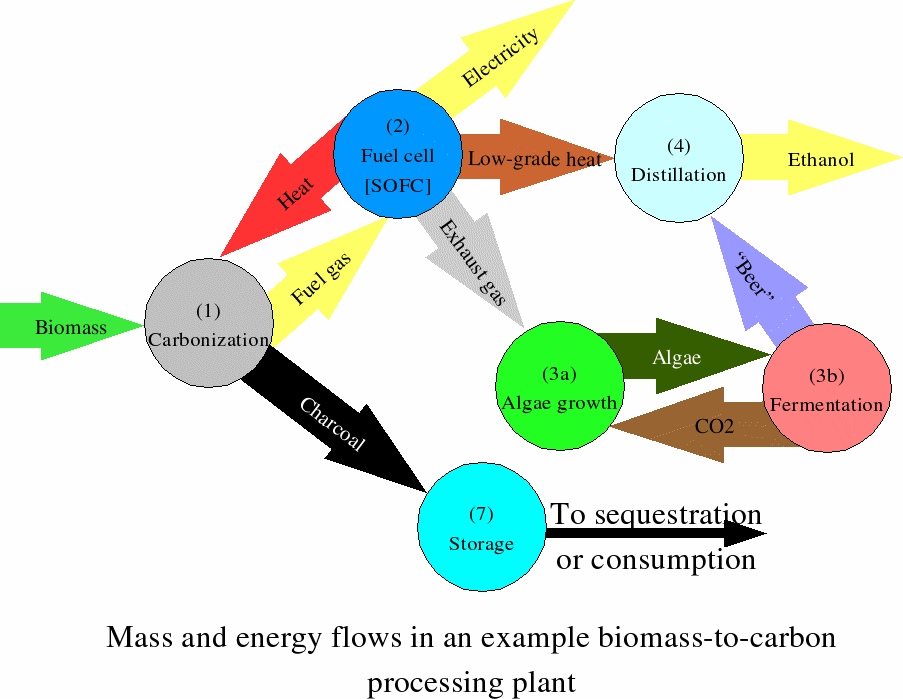
A biomass solution to US oil and electricity "issues"
The author argues for a closed cycles system of generating electricity and providing fuel for vehicles in a carbon neutral and possibly carbon negative cycle. He does a good job of tackling and suggesting existing technologies as well as that would need to be developed or improved for the cycle to work. Additionally, he makes some policy proposals for how to drive the development of this cycle in an economically generous way.
Here's the cycle:

Big things the system is relying on:
1) cellulosic feed stocks to feed the system
2) PHEV and Electric passenger vehicles
3) ethanol as the sole liquid fuel for vehicles
4) Algae to convert gaseous CO2 to C, O2 and "beer" for producing ethanol
5) fuels cells based on carbon
6) Generation of charcoal for long term sequestration
I won't claim that its perfect, or that I think he's completely right, but its certainly interesting, and could quite possibly be a part of the solution could be used. I have no idea the development status and current ability to deploy some of the technologies he mentions, such as solid-oxide fuel cells, direct-carbon fuel cells, and the Ford/MIT ethanol-injection engine. Assuming he is correct, there is a market for all of the outputs from a reactor/process built to do this (electricity, ethanol, charcoal, heat), it would be interesting for someone to build the pieces that are ready now and test the process out.
Powered by ScribeFire.
Posted by Matt at 7:20 PM 0 comments
Labels: energy, transportation
Thursday, December 6, 2007
Aptera the outsider to the auto market
The analysis is right on the money for at least this consumer. The attraction of an extremely fuel efficient vehicle at a reasonable price in a distinctive and showy styling is palpable. Yes, it looks odd, and will probably get made fun of by serious car heads. I'll get over it.
Powered by ScribeFire.
Posted by Matt at 4:06 PM 0 comments
Labels: transportation
Tuesday, December 4, 2007
Read this while I work on a diatribe...
So, that said, Bill Becker, Executive Director of Presidential Climate Action Project, has responded to the request for a vision. It may not be the perfect vision, it may not answer all the questions possible (see the comments), but at least there is one, and its been publicly stated.
Perhaps this is a very useful direction for the conversation to take. Instead of preaching doom, gloom and the general patheticness of our species, lets get a vision for where we will be in 10, 20, 30 and 40 years, then figure out how to get there. Its no different that any other target. Man on the moon in seven years, seemed insurmountable, but it happened. Automakers CAFE standards to 35mpg by 2020, okay, that doesn't even seem like that much of a challenge.
Powered by ScribeFire.
Posted by Matt at 4:23 PM 0 comments
Labels: agriculture, environment, sustainability, transportation, vision
Saturday, December 1, 2007
Video discussing some of the ethics of using an automobile
Part of it discusses issues specific to NYC. Some of the broader ethical questions that are discussed aren't new, though its nice to hear them voiced. Most are rooted in the car obsessed and centered society that we have created and the tradeoffs that are made between convenience for one group or for ourselves versus some benefit to another person or community.
Powered by ScribeFire.
Posted by Matt at 4:12 PM 0 comments
Labels: ethics, transportation